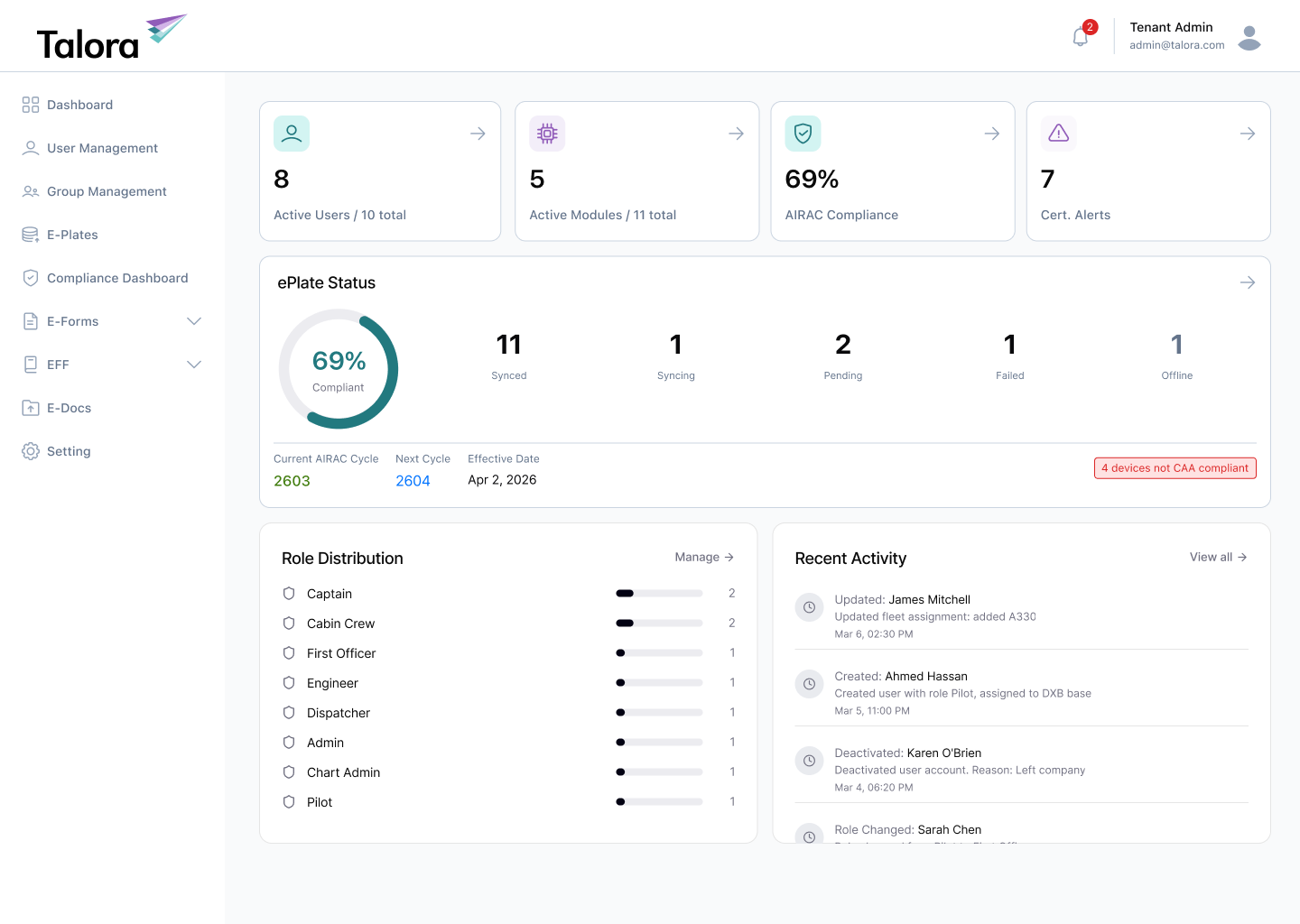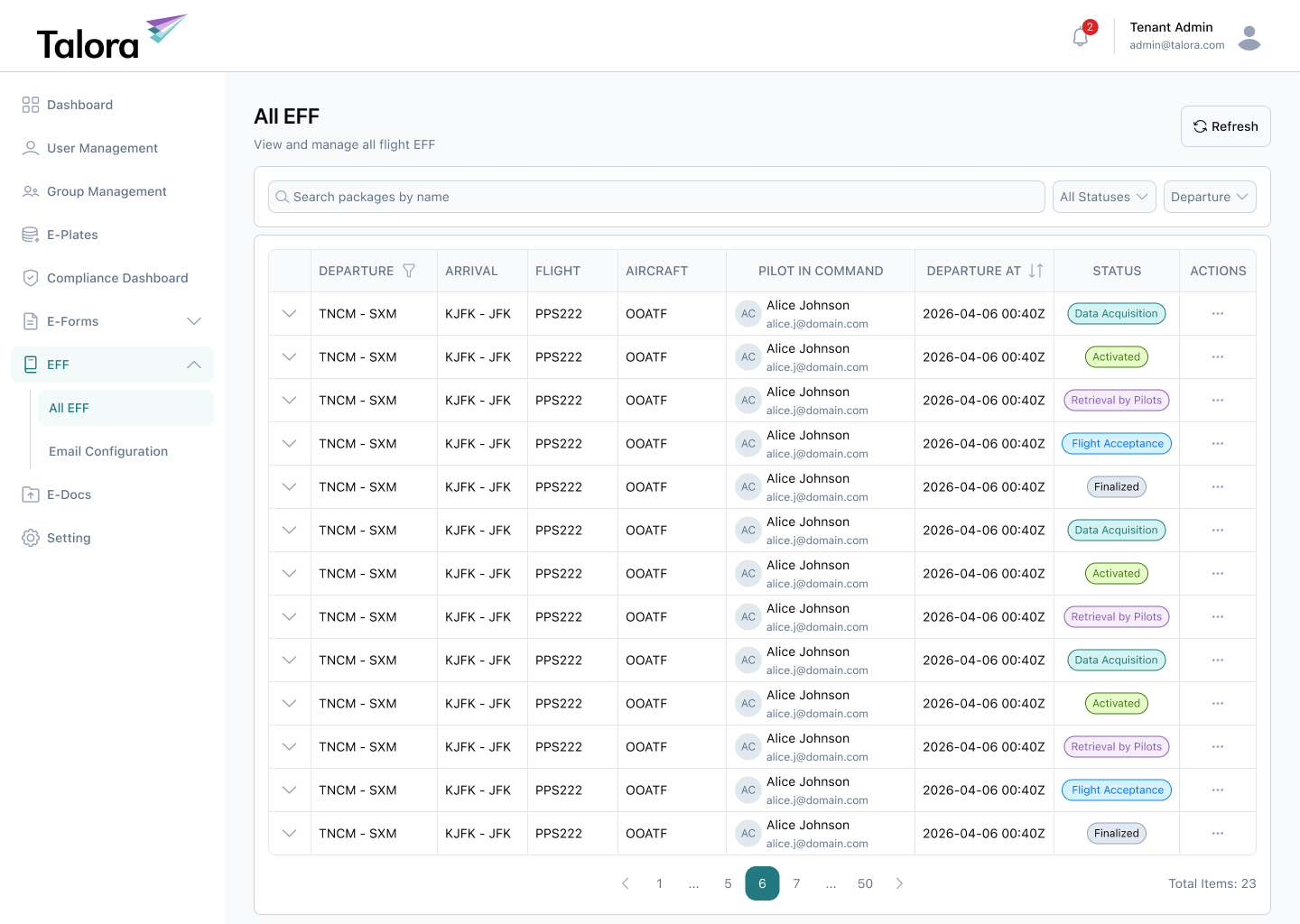
A multi-tenant administration portal for the Talora Electronic Flight Bag platform — giving airlines one place to manage users, devices, documents, and navigation charts across 7+ operational modules.
Talora Web Admin is the administration backbone of the Talora EFB platform. It spans 7+ core modules — Talora Admin (multi-tenant), User & Device Management, EDocs, EForms, EPlates, System Integration, and the Admin Integration Control Center — serving two very different kinds of administrators.
The EFB/EFF market is dominated by two ecosystems — Boeing/Jeppesen and Airbus/NAVBLUE — with deep integration moats. The market's direction of travel is AI-augmented, advisory decision support, not autonomous operation. Talora positions itself as a phased-AI, advisory-first platform focused on regional and mid-sized airlines that the incumbents price out.
We mapped the full-platform EFB vendors on product scope and AI maturity, then compared each Talora module against its direct rivals to locate where differentiation is realistic — and where integration beats building.
| Vendor | Product | Strength | AI status |
|---|---|---|---|
| Boeing / Jeppesen | FliteDeck Pro, Fleet Insight | Largest ecosystem; production AI assistant ("Elrey", 2025); tail-specific fuel advisories | AI in production |
| Airbus / NAVBLUE | Mission+ Flight Assistant | End-to-end integration: charts, weather, performance, checklists, docs | No AI claim |
| Lufthansa Systems | Lido mPilot, aiOCC | Strong OCC side (aiOCC assistant); data-rich, integrated EFB | AI in OCC |
| Thales / AvioBook | AvioBook EFB Suite | Connected suite: flight deck, cabin, OCC, maintenance | No AI claim |
| Collins Aerospace | FlightHub EFB/EFF | Real-time data; ML-based ETAs via FlightAware Foresight | ML in data layer |
| SITA | eWAS Pilot, OptiClimb | ML climb optimization; weather & turbulence awareness | ML fuel optimization |
| Bytron Skybook | Skybook EFB | Document modules, briefing integration | No AI claim |
| Criteria | Jeppesen | NAVBLUE | LH Systems | Thales | Collins | SITA | Bytron | Talora |
|---|---|---|---|---|---|---|---|---|
| Multi-tenant SaaS | ||||||||
| AI / ML features | ||||||||
| E-Plates (charts) | ||||||||
| E-Docs management | ||||||||
| E-Forms builder | ||||||||
| Configurable workflows | ||||||||
| Regional airline focus | ||||||||
| Cost flexibility |
Incumbent platforms are expensive and complex to deploy. Regional and mid-sized carriers need mainstream capability without enterprise overhead — the admin portal must feel approachable, not avionics-grade intimidating.
A shared, multi-tenant SaaS architecture is Talora's clearest structural advantage. The design consequence: strict tenant isolation made visible, so airline admins always trust whose data they're touching.
No incumbent offers a strong forms builder or truly configurable workflows. This became a differentiating module — airlines customize processes without custom development.
Partnering with Keyvan Aviation for chart content cuts licensing cost versus Jeppesen. The admin's job shifts from content management to distribution control — assignment, sync monitoring, and audit.
Airlines tailor workflows without custom development.
Lower cost, scalable across many airlines on one platform.
Advisory-first; no over-promising autonomous features.
PDF/HTML briefings for smaller airlines mid-digital-transition.
Live weather, navigation, and flight planning data.
AI tooling embedded across the development lifecycle.
The two-tier architecture demanded two personas with different risk profiles: one manages the platform across airlines; the other manages one airline's operation under regulatory scrutiny.
Internal Talora operations staff managing tenants, licenses, and feature rollouts across every airline customer.
Flight-ops administrator or document controller at a regional airline, accountable to EASA/FAA compliance audits.
Scoped the EFB/EFF landscape, its shift toward advisory AI, and where regional airlines are left behind.
Benchmarked 7 full-platform vendors plus module-level rivals; built the capability matrix.
Modeled the platform operator and the airline admin — two risk profiles, two portals.
Translated findings into a two-tier admin concept and a token-based design system.
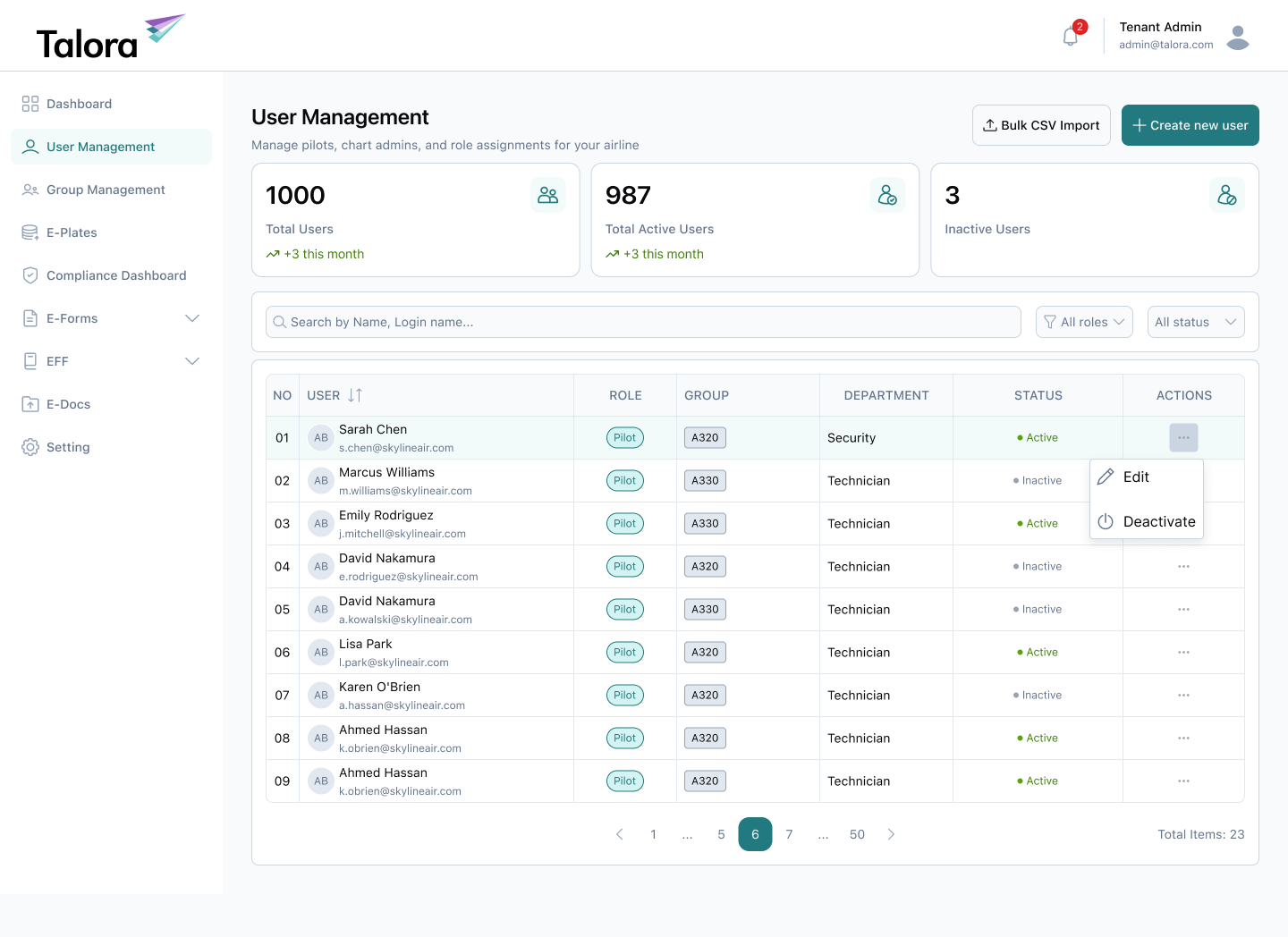
A portal for airline admins to manage user accounts, roles, permissions, and EFB devices — the front door of every tenant's operation.
Document libraries for EFB users: upload, versioning, distribution, and compliance — where an outdated manual is a safety finding, not an inconvenience.
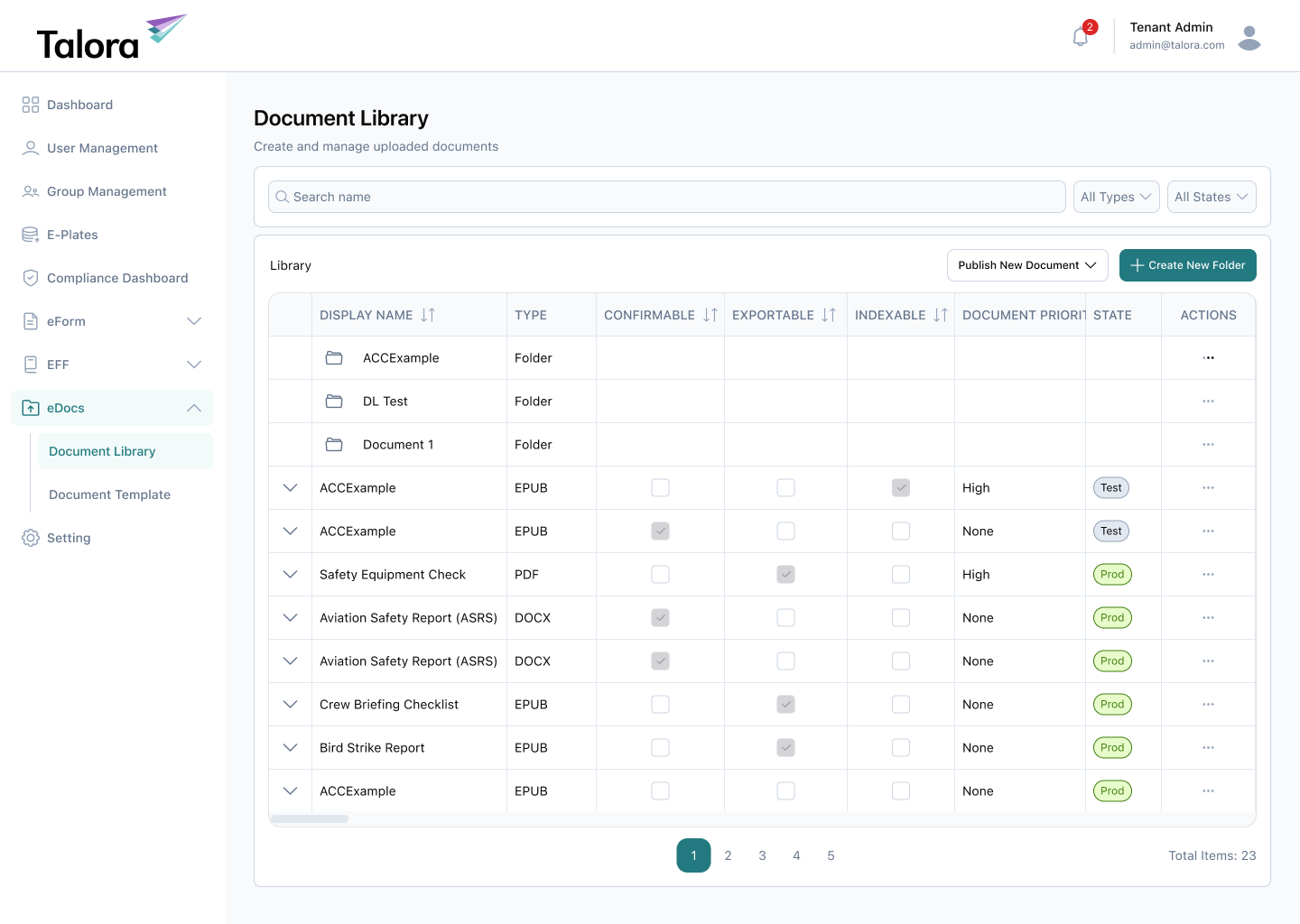
Chart content and metadata are fully managed by Keyvan Aviation — so the admin experience focuses purely on distribution and access, not content authoring.
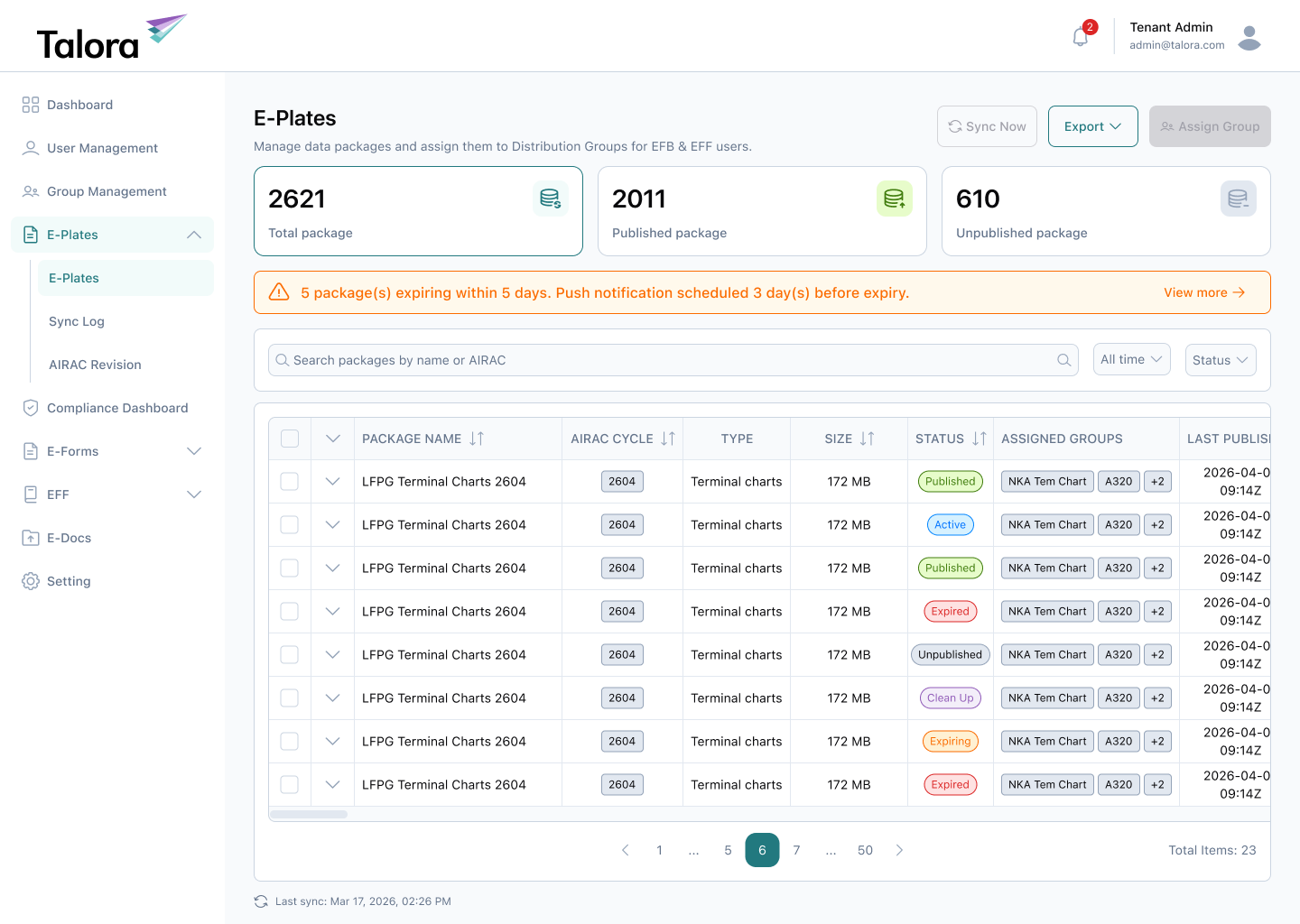
Compliance visibility and flight-folder workflows round out the admin experience — surfacing AIRAC status, device compliance, and briefing packages in one consistent design language.
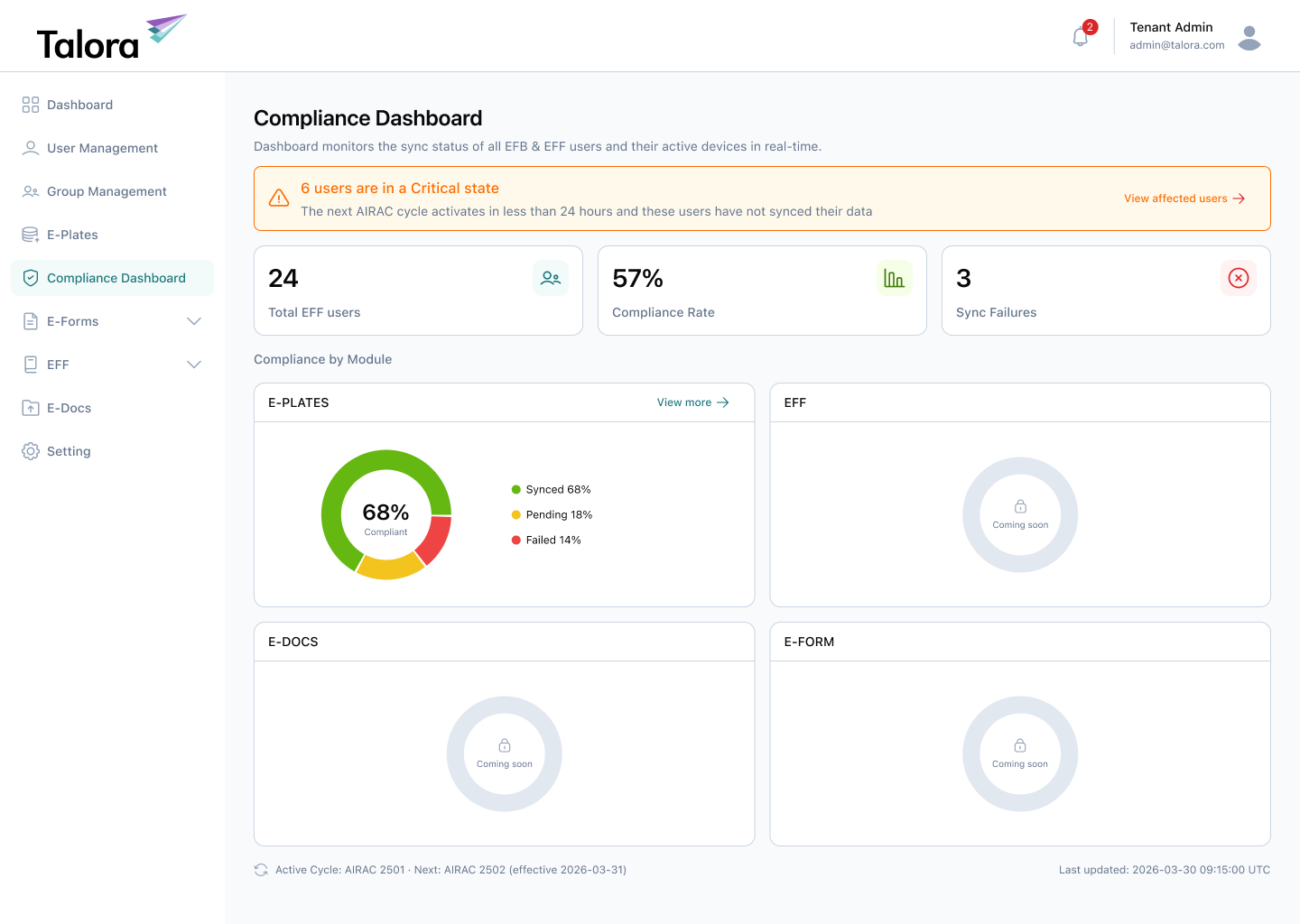
The Talora Web Admin Design System underpins every module — a token-based foundation in SF Pro, tuned for dense enterprise screens at desktop 1440px.
In aviation, audit trails aren't a feature — they're the product. Designing traceability into every module from day one shaped cleaner information architecture than retrofitting ever could.
One design serves many airlines' configurations. Every layout had to survive different feature toggles, role sets, and data volumes without breaking.
Competing with Jeppesen and NAVBLUE on feature parity is a losing game. The design bets on configurability and clarity — the things incumbents structurally can't offer.